The reverse cliquet: what is it, and what would it save at the pump?
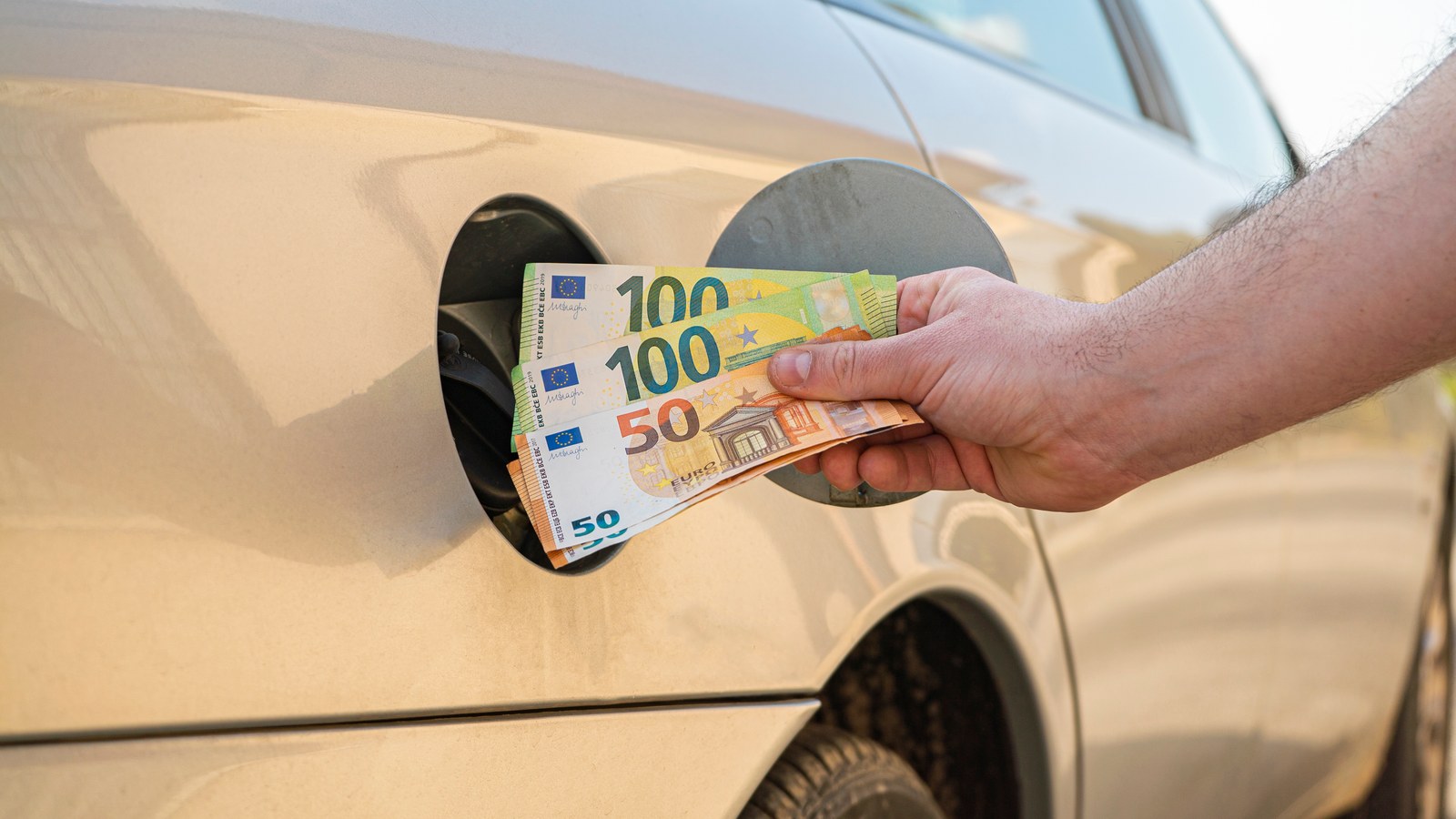
Diesel has cost at most 2.4440 euro per litre since 17 October, petrol 95 E10 2.0020 euro since 21 October. With every spike the same call goes up in Brussels: activate the reverse cliquet. The MR demands it, Vooruit and Les Engagés have backed it, the N-VA says no. But what is this cliquet exactly, and what would it really change about your fill-up? We explain it without taking sides, and we check the sums against the official figures.
First, the ordinary cliquet
Excise duty on fuel is a fixed amount per litre, not a percentage. Today it is the same for diesel and for petrol 95 E10: 0.6002 euro per litre, energy contribution included. On top of that comes 21 percent VAT, charged on the excise duty as well.
The ordinary cliquet system was introduced in 2003 to raise diesel excise step by step to the level of petrol. Each time the maximum price fell, half of that drop was converted into extra excise duty. Motorists therefore saw the price fall less than the market allowed, and the state kept the difference. Between 2004 and 2018, diesel excise rose by a total of 247.6 euro per 1,000 litres this way.
Then the reverse cliquet
The reverse cliquet does exactly the opposite. As soon as the maximum price crosses an agreed threshold, the government lowers the excise duty so the price at the pump rises more slowly. The state pays for that out of the extra VAT it collects on the higher price.
It was first used in 2005. The Verhofstadt II government froze the ordinary cliquet and applied the reverse system five times within a few months, with a diesel threshold of 1.10 euro per litre. A different variant came in 2022: after Russia’s invasion of Ukraine, the De Croo government cut excise duty by a flat 144.63 euro per 1,000 litres, 17.5 cents per litre including VAT at the pump. An ordinary cliquet was attached straight away: once the price dropped below 1.70 euro, half of every decrease went back into excise until the old rate was reached. That happened for petrol on 17 November 2022 and for diesel on 1 April 2023.
How much room is there, really?
Less than you might think. Europe imposes a minimum excise duty: 0.359 euro per litre for petrol and 0.330 euro for diesel. With today’s rate of 0.6002 euro, Belgium can give up at most 24.1 cents on petrol and 27.0 cents on diesel. Including VAT, that is at most 29.2 cents for petrol and 32.7 cents for diesel at the pump. Diesel would then go from 2.444 to about 2.117 euro, E10 from 2.002 to about 1.710 euro. That is the absolute floor, not a proposal on the table.
Smaller steps are more realistic. The 2022 scenario, 17.5 cents per litre, makes a 50-litre fill-up 8.75 euro cheaper. The transport federation UPTR is asking for a cut of 78.86 euro per 1,000 litres, around 9.5 cents at the pump, so 4.75 euro per full tank.
Does the state profit from high prices?
That is the core argument of the supporters, and it is partly right. On 31 December 2025 diesel cost 1.678 euro and a litre contained 29.1 cents of VAT. Today, at 2.444 euro, it is 42.4 cents: 13.3 cents per litre more VAT than ten months ago. For E10 the extra is 7.5 cents per litre. Economy minister David Clarinval (MR) puts the additional revenue since January at over 100 million euro.
The flip side is less well known. Whoever pays more at the pump does not spend that money elsewhere, and the VAT there disappears. The state also fills up its own vehicles at the higher price. Energy minister Mathieu Bihet (MR) admitted in the Chamber committee that the state does not get richer in periods of high energy prices. And finance minister Jan Jambon (N-VA) had the cost of a cut calculated: every cent less at the pump costs the treasury 114,000 euro a day for petrol and 152,000 euro for diesel. Capping diesel at 2 euro would come to around 200 million euro a month.
Where the debate stands
In April the MR already demanded the cliquet, with Vooruit and Les Engagés behind it. Prime minister Bart De Wever (N-VA) refused and the government opted for a targeted package of 80 million euro: 60 million for a temporarily higher mileage allowance from May to July, 15 million for the social energy funds and 5 million for people who need their car for work.
Since September’s diesel records the proposal is back on the budget table. Clarinval and Bihet defend it, Jambon and De Wever point to a deficit heading towards 40 billion euro by 2029, and the governor of the National Bank sees no room for general price measures. The multi-year budget even pencils in an increase of the special excise duty on petrol and diesel from 1 January 2027. At the time of writing there is no decision.
What this means for you
As long as there is no royal decree, nothing changes about the maximum price we track every working day. If the cliquet does come, you will not see it as a separate line on your receipt but as a lower maximum price in the official list of the FPS Economy. We will report it the day it takes effect, with the exact amount.
Source: Energia - Composition of the maximum price of petrol and diesel on 31 December 2025, BRAFCO - Current maximum prices, European Commission - Energy Taxation Directive, minimum rates, FPS Finance - Temporary reduction of the special excise duty 2022 and cliquet system, National Bank of Belgium - Naar meer milieuheffingen?, Trends - 200 millions d’euros par mois, le prix du cliquet inversé selon Jan Jambon, Mobility Energy - Regering bereikt akkoord over brandstofcrisis, Flows - UPTR vraagt lagere accijnzen.