Filling up abroad - is it worth it, and is it even legal?
Anyone driving to Luxembourg for a holiday often sees the pump price sitting lower than at home. Anyone heading to the Netherlands sees the opposite. Is that gap big enough to justify a detour, and does the law even allow it? This piece checks it against official figures, not a memory from last summer.
The numbers: what a litre really costs
Source for every comparison below: the European Commission’s Weekly Oil Bulletin, the weekly price return every member state is required to submit, here the reading of 28/09/2026, prices including VAT and excise duty.
| Country | Petrol (€/L) | Diesel (€/L) |
|---|---|---|
| Belgium | 2.0319 | 2.4305 |
| Netherlands | 2.4646 | 2.5260 |
| Germany | 2.3450 | 2.4370 |
| France | 2.2128 | 2.3706 |
| Luxembourg | 1.8880 | 2.0950 |
Source: European Commission - Weekly Oil Bulletin, prices with taxes.
Translated into a 50-litre tank, the difference against Belgium:
| Country | Petrol difference (50 L) | Diesel difference (50 L) |
|---|---|---|
| Netherlands | + €21.63 more expensive | + €4.78 more expensive |
| Germany | + €15.65 more expensive | + €0.33 more expensive |
| France | + €9.04 more expensive | - €2.99 cheaper |
| Luxembourg | - €7.20 cheaper | - €16.77 cheaper |
Only Luxembourg is structurally cheaper than Belgium for both fuels. France is now slightly cheaper for diesel and more expensive for petrol; Germany is nearly even for diesel and more expensive for petrol. The Netherlands remains the most expensive of the five countries for both fuels, though its diesel margin has narrowed.
Where the gap comes from: excise duty, not market price
The underlying crude oil price is nearly identical across Western Europe. The gap between countries sits almost entirely in national taxes, not in the actual cost of the fuel:
| Country | Petrol excise (€/1,000 L) | Diesel excise (€/1,000 L) |
|---|---|---|
| Netherlands | 848 | 558 |
| France | 690.2 | 607.5 |
| Germany | 662.3 | 491.8 |
| Belgium | 600.16 | 600.16 |
| Luxembourg | 526.38 | 421.87 |
Source: European Commission - Oil Bulletin Duties and Taxes, 1 October 2026 (excise and other indirect taxes, such as the carbon levy, excluding VAT).
The Netherlands levies well over one and a half times Luxembourg’s rate on petrol. The gap is smaller for diesel, because Luxembourg taxes diesel relatively more heavily against its own petrol rate. That explains why Luxembourg’s discount is bigger on petrol than on diesel: the country deliberately keeps petrol excise low to attract fuel tourism.
Is it legal to fill up abroad?
Yes, without any doubt, and it follows directly from EU law. Under Article 24 of EU Directive 2003/96/EC, a private individual is free to travel anywhere in the EU and fill up wherever they like: fuel in a vehicle’s standard tank is never taxed a second time, even when crossing a border with a full tank. This is a basic principle of the internal market, not a loophole.
Source: EUR-Lex - Directive 2003/96/EC, Article 24, Europa.eu - Travelling within the EU: excise duties.
The limit sits at the jerrycan, not the tank
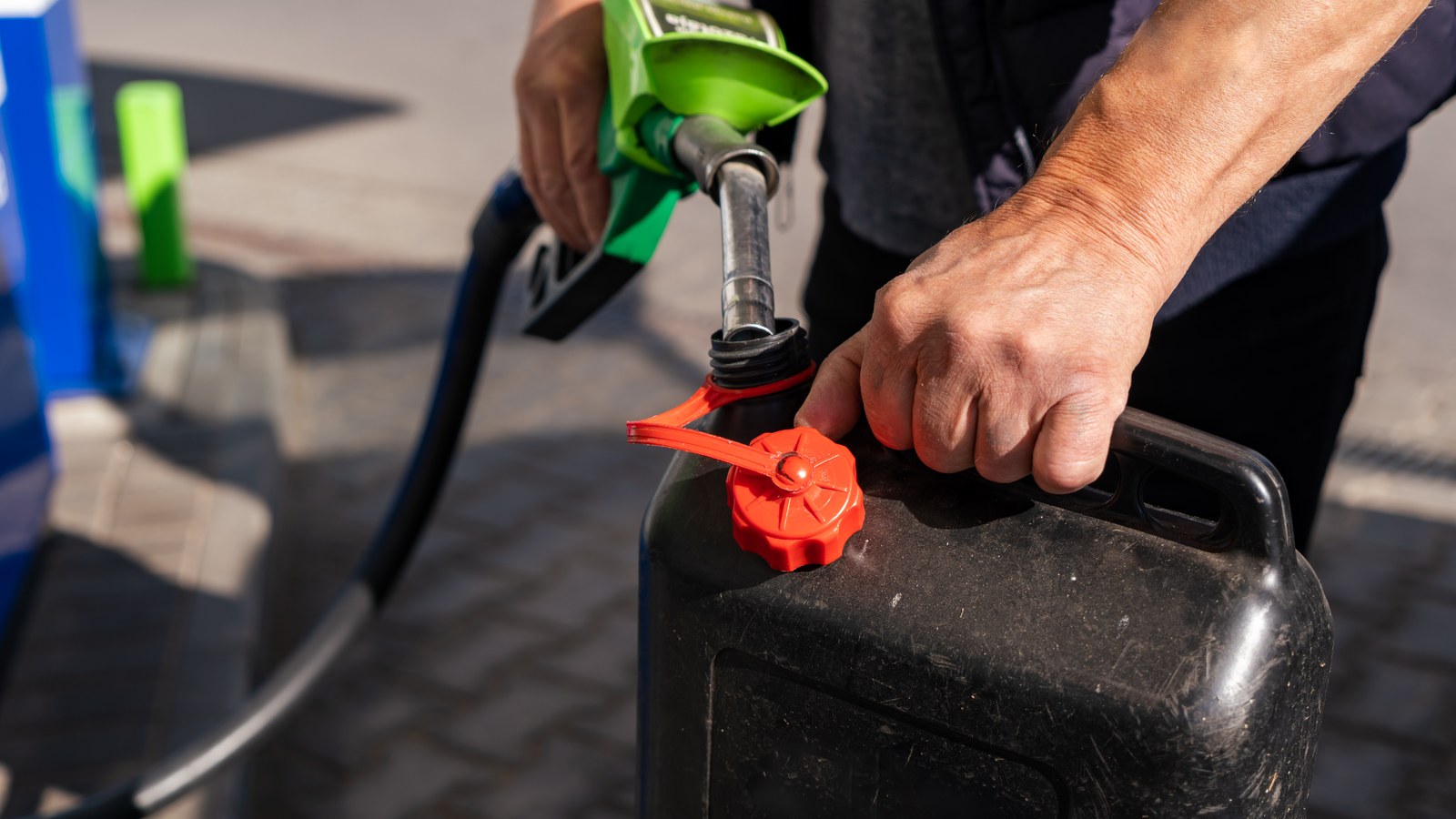
What is restricted is fuel carried separately, outside the fixed tank. The same EU directive allows an additional 10 litres maximum in a portable container duty-free. Belgian customs also applies a practical ceiling on top of that: up to 240 litres may be carried in approved jerrycans of at most 60 litres each, but anything above the 10-litre reserve allowance is in principle liable for excise duty on arrival in Belgium.
Is this enforced? Rarely systematically, but customs can impose a back-payment and a fine on inspection if undeclared reserve fuel is found. Storing large quantities of fuel at home also carries a real fire risk, quite apart from the tax question.
Source: FPS Finance - “Travel wisely” brochure, EUR-Lex - Directive 2007/74/EC, Article 11.
Conclusion: filling your tank in Luxembourg and driving back to Belgium is 100% legal, every single day. Bringing back jerrycans to stockpile at home is not, unless you stay under 10 litres.
Is it actually worth a special trip?
The table above shows the gross saving. Two things immediately cut into it:
- The detour itself. A 40 km detour to fill up in Luxembourg burns fuel getting there and back: at an average 6 L/100 km, 80 km round trip costs about 4.8 litres, roughly €10 at Luxembourg’s diesel price. That eats a large chunk of the €16.77 saving on a full tank.
- Time. For anyone already passing that way (cross-border commuters, through-traffic, holidays), the saving is nearly free. For anyone planning a dedicated trip, the sums get much tighter, and can even turn negative.
Rule of thumb: filling up in Luxembourg pays off mainly for people who are driving that way anyway. A dedicated trip rarely pays for most drivers, unless a large diesel tank is nearly empty and the detour stays minimal.
In summary
- Only Luxembourg is structurally cheaper than Belgium for both fuels. The Netherlands is the most expensive of the five countries compared, though its diesel margin has narrowed.
- The gap between countries comes almost entirely from national excise duty, not the market price of oil.
- Filling up in another EU country and driving back with a full tank is fully legal, however often you do it.
- Reserve fuel in jerrycans is limited to 10 litres duty-free; beyond that you risk a back-payment.
- Factor in the detour cost before drawing conclusions: the saving on paper is not always the saving in your wallet.
Pompprijs.be keeps its focus on the Belgian maximum price, but a look across the border is worthwhile now and then - with numbers, not a hunch.